In this project, we aim to investigate the impact of a neutron star jet on the Common Envelope Evolution (CEE) process. The Common Envelope Evolution occurs in binary star systems where one star expands and engulfs its companion within its envelope. This interaction leads to the formation of a close binary system, which can undergo various evolutionary paths.
During the common envelope phase, the orbital energy of the binary system is transferred to the envelope, resulting in the inspiral which can either lead to ejection of the envelope or merger of the core and companion. The CEE process plays a significant role in the formation of compact binaries, such as binary neutron star systems.
In this section, we describe the methodology and setup employed in our study of Common Envelope Evolution using Adaptive Mesh Refinement (AMR) techniques with the ASTROBEAR code. The simulation setup involved a detailed consideration of the stellar parameters, computational domain, and resolution levels.
Jet material The primary star in our simulation has a mass of 1.96 and a radius of 48.1R⊙. Within the primary star, the core contains a mass of 0.37M⊙. The secondary star has a mass of 0.98M⊙ and is situated at a distance of 49.0R⊙ from the primary star.
The computational domain, or simulation box, was set to dimensions of 1150R⊙ × 1150R⊙. This adequately encapsulates the physical region of interest for the common envelope evolution process, ensuring that the interaction between the two stars and the ensuing envelope ejection can be accurately simulated.
We employed Adaptive Mesh Refinement (AMR) techniques to ensure that our simulations achieved both high accuracy and computational efficiency. The highest resolution utilized in our simulations was 0.140R⊙, which allowed us to capture intricate details of the common envelope evolution. Additionally, we used a base resolution of 2.25R⊙ in regions where a coarser grid was sufficient, optimizing our computational resources.
We specify the density and pressure of the ambient medium such that we can resolve the pressure height scale with the availaible computatinal resources. The density of the ambient medium was set to 6.7 × 10⁻⁹g cm−3 . The pressure was chosen to be 1.0 × 10⁵dyn cm−2 .
As the envelope material starts accreting on to the secodnary, we can calculate this rate of accretion. Using the virial theorem, which states that half the liberated potential energy is added to the accretor in the form of thermal energy. Assuming the opacity due to electron, we find the following expression for the mass accretion rate on to the secondary
where \(R_*\) is the radius of the companion and \(\tilde{\lambda}\) is the efficieny parameter that depends on the density profile
Following definition for gas "unbound" has been used
The following table shows the details of the simulation runs conducted in this project:
| Run | Significance | \(\dot{M}_j (10^{-5} M_\odot)\) yr\(^{-1})\) | \(v_j\) (km/s) | \(\dot{M}_\mathrm{Edd}\) \(M_\odot)\ yr\(^{-1}\) | \(\dot{M}_{acc} (M_\odot) \) yr(\{-1}) | MinDensity (g/cc) | \(\dot{M}_j / \dot{M}_\mathrm{Edd}\) | Restart_time(frame) | MaxLevel | Status |
|---|---|---|---|---|---|---|---|---|---|---|
| J8 | WD run | 2 | 8640 | 2.1 × 10⁻⁵ | 0.2 | 1e-10 | 0.95 | 0 d | 4 | Complete |
| 001 | Higher \(\dot{M}_j\) | 20 | 8640 | - | 0.2 - 1.0 | 1e-10 | - | 19.91 d (86) | 4 | Complete |
| 003 | NS run (High \( \dot{M}_j \) and \(v_j\)) | 20 | 30000 | 3.4 × 10⁻¹⁰ | 0.1 to 1.0 | 1e-10 | \(5.9 \times 10^{6}\) | 19.91 d(86) | 4 | Complete |
| 004 | No-Accretion NS run | 20 | 30000 | 3.4 × 10⁻¹⁰ | 0 | 1e-10 | \(5.9 \times 10^{6}\) | 19.91 d(86) | 4 | Complete |
| 005 | Lower MinDensity | 20 | 30000 | 3.4 × 10⁻¹⁰ | - | 1e-12 | \(5.9 \times 10^{6}\) | 33.80 d(146) | 4 | Complete |
| 006 | High Resolution | 20 | 30000 | 3.4 × 10⁻¹⁰ | - | 1e-12 | \(5.9 \times 10^{6}\) | 19.91 d(86) | 5 | frame 93 |
| 007 | Low Resolution | 20 | 30000 | 3.4 × 10⁻¹⁰ | - | 1e-12 | \(5.9 \times 10^{6}\) | 19.91 d(86) | 3 | Complete |
| 008 | Started at an earlier time | 20 | 30000 | 3.4 × 10⁻¹⁰ | - | 1e-14 | \(5.9 \times 10^{6}\) | 14 d(60) | 4 | Complete |
| 009 | Higher \(\dot{M}_j\) | 200 | 30000 | 3.4 × 10⁻¹⁰ | - | 1e-12 | \(5.9 \times 10^{7}\) | 20 d(60) | 4 | frame 102 |
| 011 | No Accretion, Started at an earlier time | 20 | 30000 | 3.4 × 10⁻¹⁰ | - | 1e-12 | \(5.9 \times 10^{6}\) | 14 d(60) | 4 | Complete |
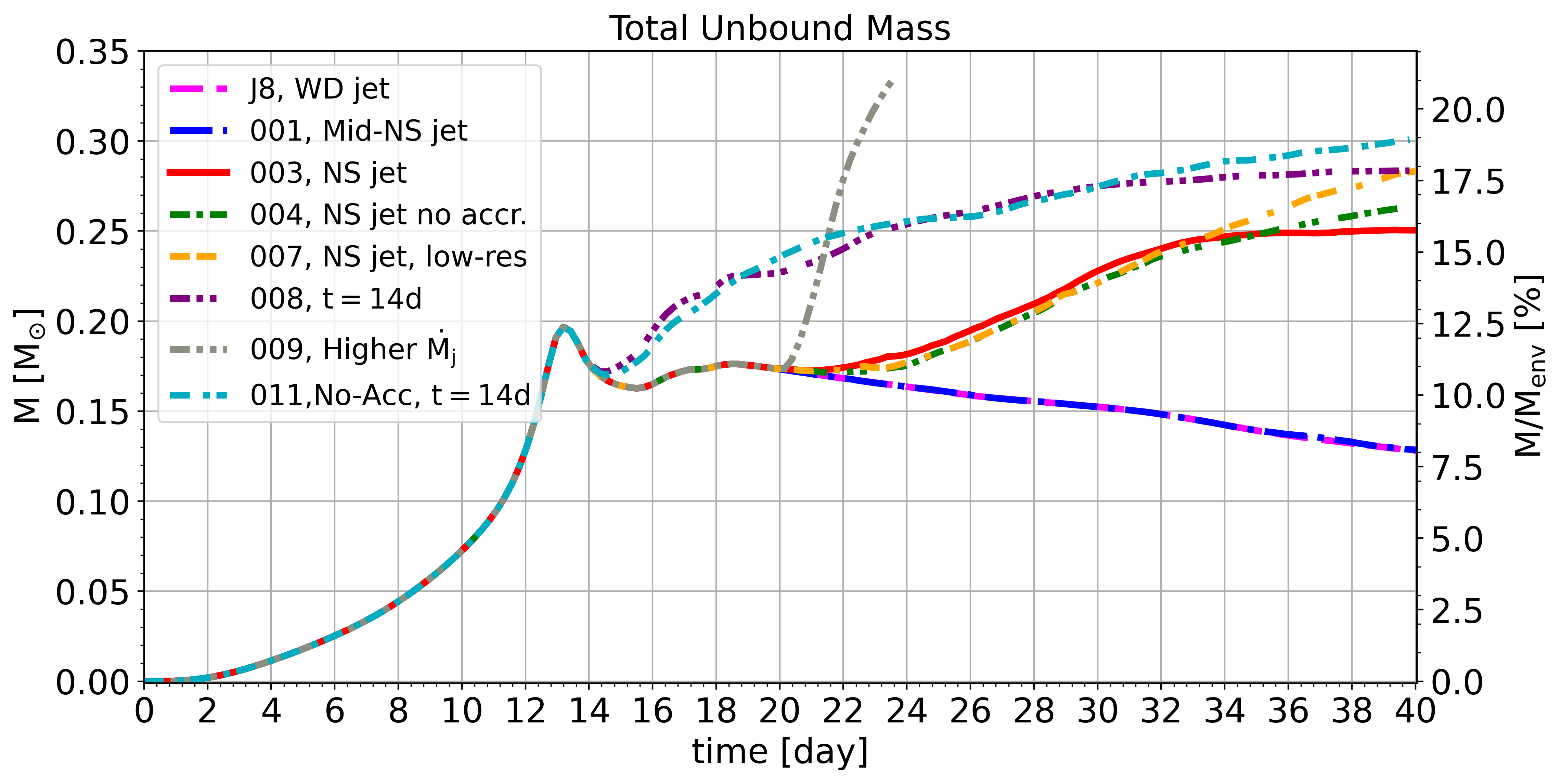
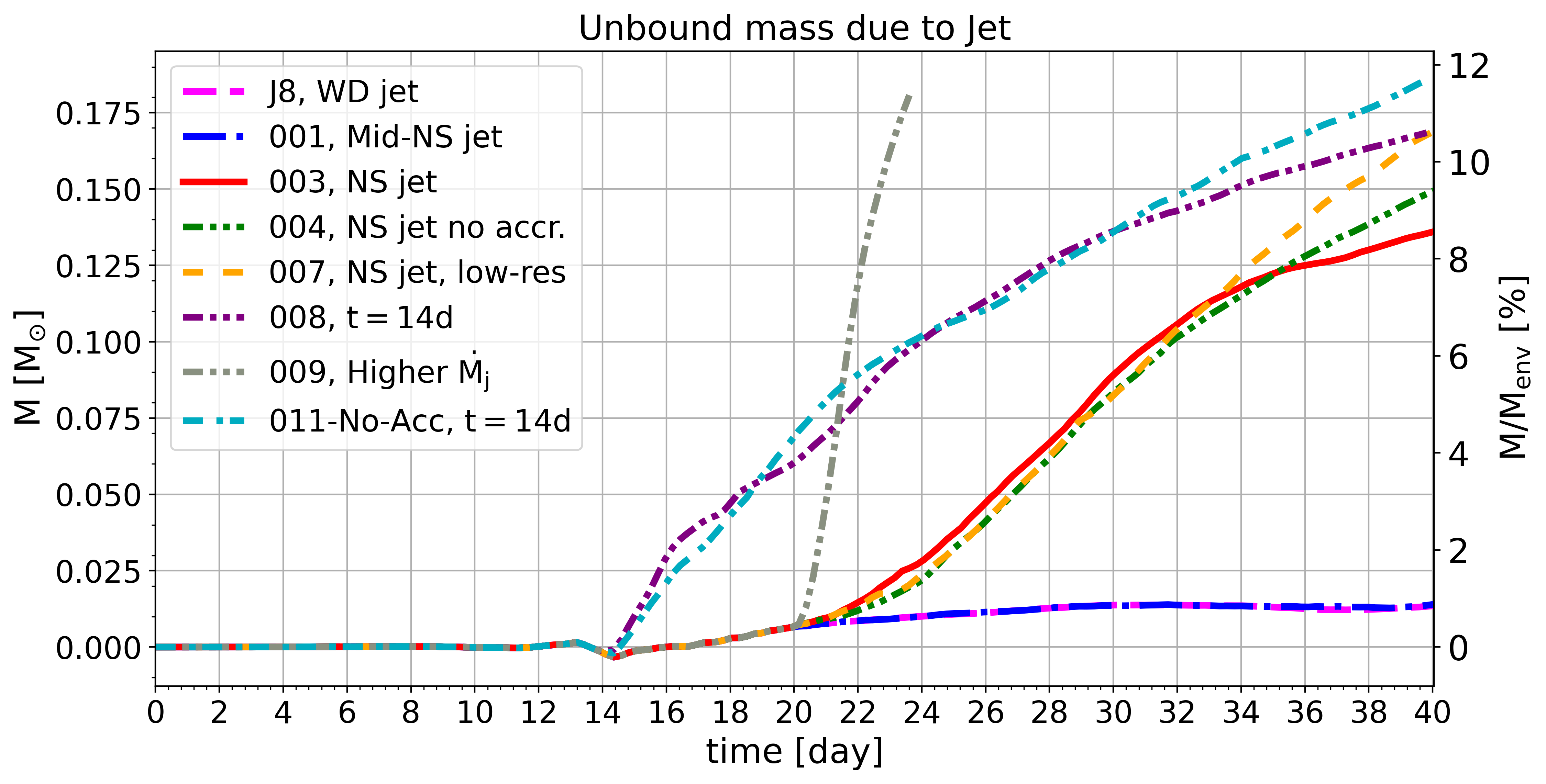
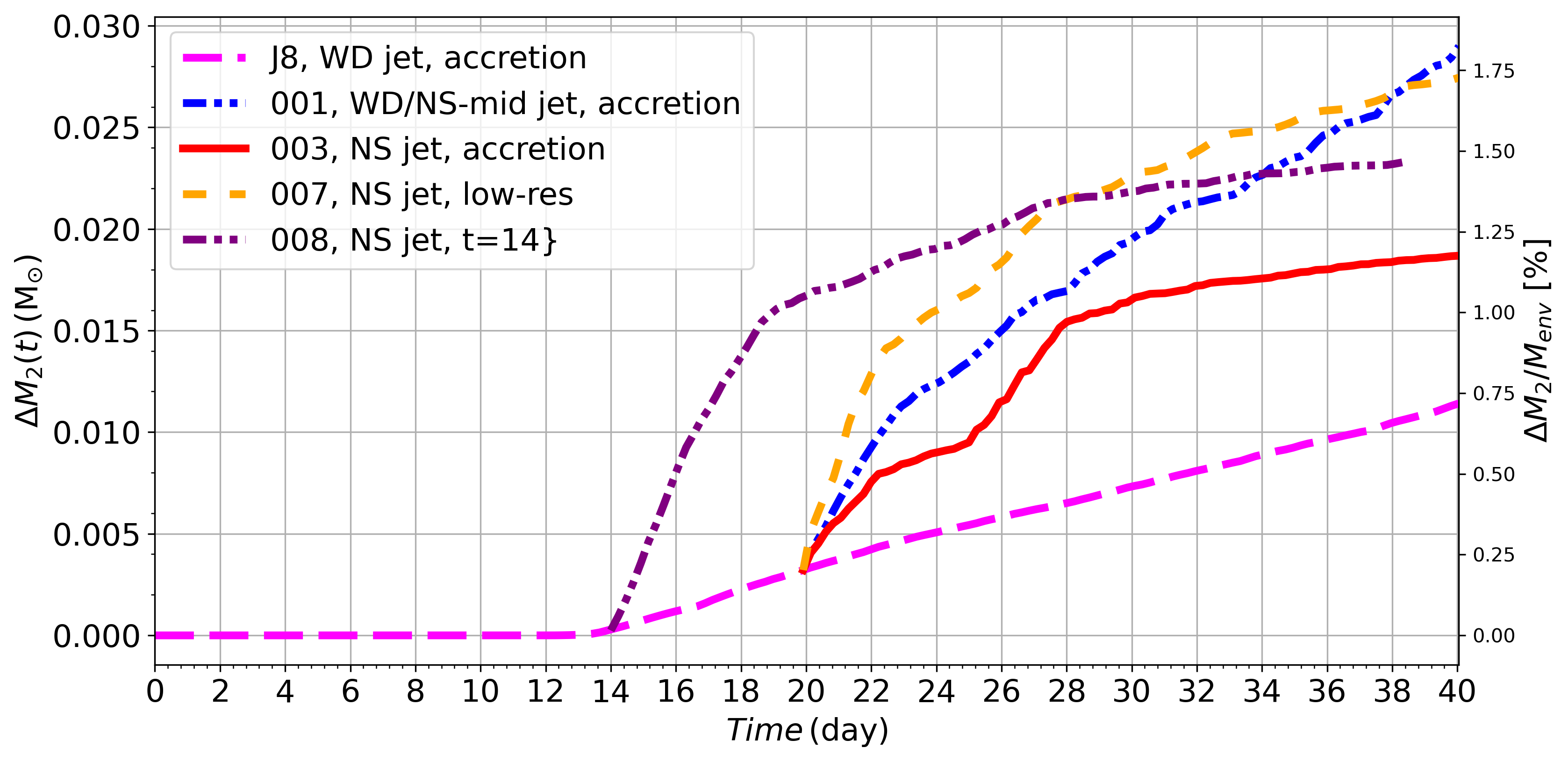
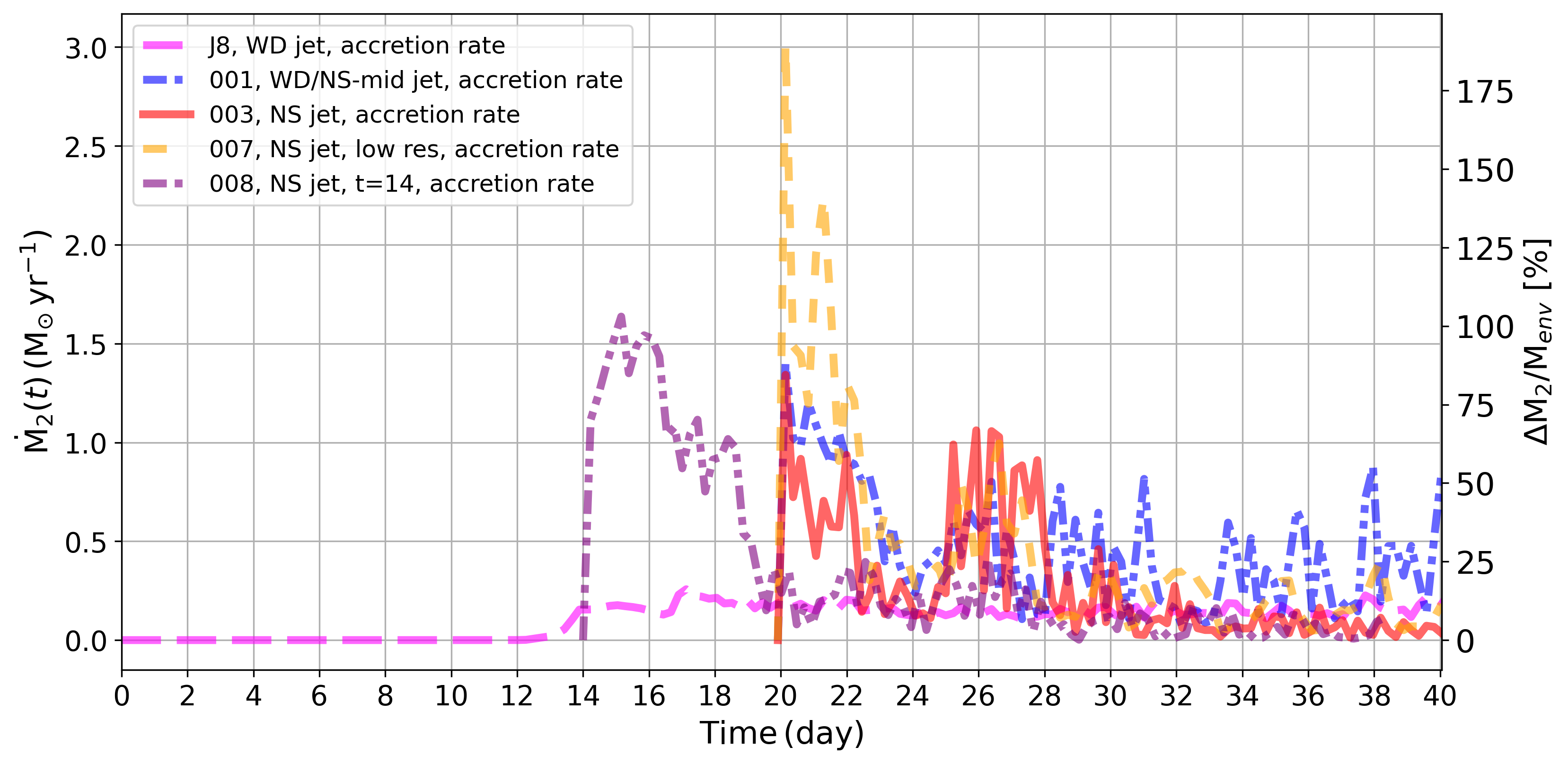
Below are link to the plots showcasing the simulation of a neutron star jet and its effect on the Common Envelope Evolution: